Monday, May 18, 2009
Self Evalutation
Over all this year, I think I've done better this year in A.P. than I thought I was going to. The class has a reputation for being difficult, like all AP classes do. But this class wasn't filled with really hard work like I thought it was going to be, just filled with a lot of work, with some of it being difficult (something you usually can't escape in any class). In some ways I think I've done well for some parts of this project and not so well on other parts. The times when I did do my posts on time they usually turned out okay, although they were often rather short. I was never sure how long each post was supposed to be. But at one point where a particular post was hard to write about, so I put it off, and while I kept up with my following posts, I saved them as drafts and only just actually posted them. It was sometimes also difficult to think of what to do a blog on, especially during the weeks we did presentations. I did enjoy looking up other "extra" stuff to put on here, like the articles from Discovery.com. The worst part was probably the art discussions and connections across time.

Sunday, May 17, 2009
Hitler Watercolors Draw Big Bid at Auction
What a British auction house claims are a set of paintings and sketches by a young Adolf Hitler sold at auction Thursday for 97,672 pounds ($143,358).
Among the 15 pictures is a portrait of solitary figure dressed in brown peering into wine-colored waters. The date is 1910, the signature reads "A. Hitler" and scribbled just over the mysterious figure are the letters: "A.H."
So is this a portrait of the Fuehrer as a young man?
"I don't think they're fakes," said Richard Westwood-Brookes, historical documents expert at auction house Mullocks that carried out the sale. He said he did not believe anyone would have the nerve to fake the pictures, given the global publicity they have received.
Among the 15 pictures is a portrait of solitary figure dressed in brown peering into wine-colored waters. The date is 1910, the signature reads "A. Hitler" and scribbled just over the mysterious figure are the letters: "A.H."
So is this a portrait of the Fuehrer as a young man?
"I don't think they're fakes," said Richard Westwood-Brookes, historical documents expert at auction house Mullocks that carried out the sale. He said he did not believe anyone would have the nerve to fake the pictures, given the global publicity they have received.
Tuesday, May 12, 2009
Meeting of the Minds: Henry VIII Part 2
Many of the things that Henry VIII did in his lifetime sound like a cliche, fairytale, spoiled rotten prince. It probably wasn't complete his fault that he acted like that for most of his life. First of all, he was royal. He was entitled to have nearly everything he could ask for. Second, Henry wasn't raised to be prince, his older brother was. Henry was supposed to go into the clergy, but when his brother Arthur died Henry then got a crash course in being a king instead of the real thing. Third, his father Henry VII was a tightwad, and when Henry VIII inherited the throne he was left with a ton of money that he nearly instantly began to waste. But all of that doesn't excuse all of the ridiculous things he did during his reign (not that he was the first or last ruler to do anything crazy).
Meeting of the Minds: Henry VIII Part 1
In preparation for this assignment I signed three books out of the James V. Brown Library about a month ago, one of which I've read front to back and another of which I skimmed through. Having previously read Antonia Fraser's book The Wives of Henry VIII for our summer reading project, reading just about Henry VIII was quite a different experience than I thought it would be. The Henry portrayed in Fraser's book had little to do with state, but in Monarch and Conspirators: the Wives and Woes of Henry VIII, more of his attempts at war and in peace were talked about. Although I'm sure it came up, I don't remember reading about the Field of the Cloth of Gold before, but in the books not about Henry VIII's wives, it comes up quite often in in great detail.
One thing I thought would be different between the books was the way Henry VIII's personality and demeanor was portrayed. Fraser's book made him seem like a selfish, stubborn, sometimes passionate man who was prone to temper tantrums. This is how he's portrayed in most other books about him as well. I thought perhaps books about him specifically would be more kind.
I've also checked out of the school library a copy of Bolt's play A Man for All Seasons. I've seen the movie before, so I can recall somethings from that, but otherwise so far I haven't read far enough for many things to sound familiar from reading other reference books.
One thing I thought would be different between the books was the way Henry VIII's personality and demeanor was portrayed. Fraser's book made him seem like a selfish, stubborn, sometimes passionate man who was prone to temper tantrums. This is how he's portrayed in most other books about him as well. I thought perhaps books about him specifically would be more kind.
I've also checked out of the school library a copy of Bolt's play A Man for All Seasons. I've seen the movie before, so I can recall somethings from that, but otherwise so far I haven't read far enough for many things to sound familiar from reading other reference books.
Thursday, May 7, 2009
Presentation #4
Presentations from 5/6: Bosnia, Darfur, 9/11 and Al-Qaeda.
For someone like me who has done little to no research on either the human rights issues in Rwanda, Bosnia, and Darfur, it’s somewhat difficult to keep any of the details straight. Without looking at the notes I took I’d never be able to tell you if the Janjaweed were in Darfur or Rwanda, or which country the Hutu and the Tutsi were fighting in. It all gets mashed together into one big human rights issue.
For someone like me who has done little to no research on either the human rights issues in Rwanda, Bosnia, and Darfur, it’s somewhat difficult to keep any of the details straight. Without looking at the notes I took I’d never be able to tell you if the Janjaweed were in Darfur or Rwanda, or which country the Hutu and the Tutsi were fighting in. It all gets mashed together into one big human rights issue.
Monday, May 4, 2009
Presentations #3
Presentations from 5/5: International Monetary Fund/ World Bank, Human Rights and Genocide, Promoting Human Rights, and Rwanda.
Due to the presentations from that day being similar in nature (with the exception of the World Bank) some of the topics seem like they could have been combined into one instead of multiple presentations. The Human Rights section doesn’t really give any major information that isn’t common knowledge, and it seems to me as though that and Promoting Human Rights could be one report.
Due to the presentations from that day being similar in nature (with the exception of the World Bank) some of the topics seem like they could have been combined into one instead of multiple presentations. The Human Rights section doesn’t really give any major information that isn’t common knowledge, and it seems to me as though that and Promoting Human Rights could be one report.
Thursday, April 30, 2009
Presentations #2
Today we covered the Chinese Civil War, OPEC, and NATO. As for the war and NATO, we reviewed all the main points, most of which we already knew from class, and also covered details which we probably would not be required to know unless we're on Jeopardy.
Wednesday, April 29, 2009
Presentations #1
The first two days of presentations have gone well for the most part. It's been either a good refresher for things we've already learned or a simple way to learn the material, depending on the topic. Going over the Korean War again was helpful. Like Mike said, it often gets lost in between the World Wars and Vietnam. With, in my opinion, the only noteworthy thing about the Korean War being M*A*S*H, it gets hard to keep all the information in my head and not get it confused with the Vietnam War or something else entirely. I'd forgotten all about the 38th Parallel and everything that goes along with it. I don't recall learning about the Maastrict Treaty or the euro before. What was covered in the Israel presentation was nearly impossible to take notes on, and I didn't really learn much.
Monday, April 27, 2009
6 Random Coincidences that Created the Modern World
Here's a rather funny article all about history and how it was altered by random coincidences. It covers everything from Ghengis Khan to World War I.
http://www.cracked.com/article_17298_6-random-coincidences-that-created-modern-world.html
http://www.cracked.com/article_17298_6-random-coincidences-that-created-modern-world.html
Saturday, April 25, 2009
WW2: Original 'Schindler's List' Found in Sydney Library

From Discovery.com
http://dsc.discovery.com/news/2009/04/06/schindler-list.html
April 6, 2009 -- A list of Jews saved by Oskar Schindler that inspired the novel and Oscar-winning film "Schindler's List" has been found in a Sydney library, its co-curator said.
Workers at the New South Wales State Library found the list, containing the names of 801 Jews saved from the Holocaust by the businessman, as they sifted through boxes of Australian author Thomas Keneally's manuscript material.
http://dsc.discovery.com/news/2009/04/06/schindler-list.html
April 6, 2009 -- A list of Jews saved by Oskar Schindler that inspired the novel and Oscar-winning film "Schindler's List" has been found in a Sydney library, its co-curator said.
Workers at the New South Wales State Library found the list, containing the names of 801 Jews saved from the Holocaust by the businessman, as they sifted through boxes of Australian author Thomas Keneally's manuscript material.
The 13-page document, a yellowed and fragile carbon typescript copy of the original, was found between research notes and German newspaper clippings in one of the boxes, library co-curator Olwen Pryke said.
Pryke described the 13-page list as "one of the most powerful documents of the 20th Century" and was stunned to find it in the library's collection.
"This list was hurriedly typed on April 18, 1945, in the closing days of WWII, and it saved 801 men from the gas chambers," she said.
"It's an incredibly moving piece of history."
She said the library had no idea the list was among six boxes of material acquired in 1996 relating to Keneally's Booker Prize-winning novel, originally published as "Schindler's Ark."
The 1982 novel told the story of how the roguish Schindler discovered his conscience and risked his life to save more than 1,000 Jews from the Nazis.
Hollywood director Steven Spielberg turned it into a film in 1993 starring Liam Neeson as Schindler and Ralph Fiennes as the head of an SS-run camp.
Pryke said that, although the novel and film implied there was a single, definitive list, Schindler actually compiled a number of them as he persuaded Nazi bureaucrats not to send his workers to the death camps.
She said the document found by the library was given to Keneally in 1980 by Leopold Pfefferberg -- named on the list as Jewish worker number 173 -- when he was persuading the novelist to write Schindler's story.
As such, it was the list that inspired Keneally to tell the world about Schindler's heroics, she said.
Pryke said she had no idea how much the list was worth.
Schindler, born in a German-speaking part of Austria-Hungary in 1908, began the war as a card-carrying Nazi who used his connections to gain control of a factory in Krakow, Poland, shortly after Hitler invaded the country.
He used Jewish labor in the factory but, as the war progressed, he became appalled at the conduct of the Nazis.
Using bribery and charm, he persuaded officials that his workers were vital to the war effort and should not be sent to the death camps.
Schindler died relatively unknown in 1974, but he gained public recognition following Keneally's book and Spielberg's film.
He used Jewish labor in the factory but, as the war progressed, he became appalled at the conduct of the Nazis.
Using bribery and charm, he persuaded officials that his workers were vital to the war effort and should not be sent to the death camps.
Schindler died relatively unknown in 1974, but he gained public recognition following Keneally's book and Spielberg's film.
Friday, April 24, 2009
WW2: To Bomb or Not to Bomb
I think that Truman and the United States military made the right call to drop the atomic bombs on Nagasaki and Hiroshima. There were, to put it lightly, some very negative effects that came from this, but I believe it had to be done, and I have many reasons to back this up.
- It is the duty of the U.S. military to save its own cities first, not those of other countries. It was the best choice in order for the U.S. to win the war.
- Using two atomic bombs to end the war quickly was better for the U.S. economy than possibly drawing out the war for an unknown amount of time by using the same technology as before.
- It ended the war quickly, which possibly saved lives of many more thousands of soldiers, both American and Japanese. It definitely saved the lives of U.S. soldiers, but no one knows how much longer the war would have continued for.
- It was the most effective way to beat the Japanese. They were adamant about not surrendering, so the U.S. needed to prove how badly they could crush them.
- Other countries had similar atomic technology, the U.S. just built it better, first. Had the Japanese had the bombs instead, the U.S. may have gotten bombed instead, possibly more than twice.
- The U.S. gave Japan warnings ahead of time and opportunities to surrender before the bombs were deployed. The U.S. received no such warning or opportunity for surrender before Pearl Harbor.
- Hiroshima and Nagasaki were not regular civilian cities, they were industrialized military cities. Although civilians were there, so were soldiers and military equipment.
- It helped stop the spread of Communism because Stalin, at this time, was beginning to get interested in the Pacific area.
- Many more died at the Battle of Stalingrad, or even in the bombing of Tokyo than at either Hiroshima or Nagasaki.
- It showed every country on Earth what the U.S.could do. The U.S. obviously haven't had to use it again.
- It got revenge for Pearl Harbor.
- It did not completely decimate the cities. About 1/4 of Hiroshima's population was killed in the blast, not everyone died.
- Japan has since grown into a major world power. The atomic bombs obviously did not hold them back for long.
- The Japanese government had a chance to save their own people, but didn't.
Monday, April 20, 2009
WW2: Asking for Trouble
It's completely baffling to me how anyone could have thought the way issues in pre-WW2 Europe were handled would have prevented war instead of provoking it. When Hitler started breaking the rules of the Treaty of Versailles by building an army and brought his troops into the Rhineland (which was supposed to stay demilitarized) the British policy of appeasement prevented anyone from hindering Hitler's attempts. Hitler just kept taking more and more land with Austria, the Sudentenland, and Czechoslovakia. It wasn't until he broke his promise to France and Britain to not take Poland that they declared war, six years after he left the League of Nations. Giving in to Hitler's demands in order to avoid war just made the war inevitable and harder to fight. They gave Hitler his way, and by doing that gave him more support and time to plan. The war could have been easier to fight had they just denied him to begin with.
Thursday, April 16, 2009
WW2: Presentations
I think that having everyone do presentations on one small section of the text is in some ways more beneficial than reading the text yourself and going over it in class. This way, every section gets explained with more detail than we would get in the book. Even better, it's about ten times shorter with very little reading. We also get the opportunity to ask questions. I know I never would have gotten the same information in such detail by reading the book. It'd harder to lose concentration during a presentation than while sitting around reading a text book.
Monday, April 13, 2009
WWI: Connection Across Time
Between WWI and now, I've found a connection between the Versailles Peace Conference and the G20 summit that took place in London earlier this month. The Treaty of Versailles was a collaboration between countries all over the world in order to settle the fighting and disputes of World War 1. France, Britain, and the U.S. were the lead negotiators throughout the process, with them being represented by Clemenceau, Lloyd George, and Wilson. The conference was to help the countries work together and solve problems caused by the war. This is similar to the recent G20 summit but instead of discussing peace they discussed the world's financial situation. They discussed how to revive the global economy and restore financial institutions. The "Big Three" of the summit would have been Nicolas Sarkozy (France), Gordon Brown (Britain), and Barack Obama, with Dmitry Medvedev (Russia) and Angela Merkel (Germany) also playing a large role.
Sunday, April 12, 2009
WWI: Art

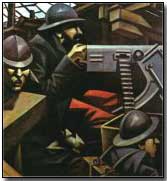
This painting by Christopher Nevinson, located on page 886 in our books, is a good representation of trench warfare during WWI. It has harsh lines and few colors. The few colors that are there are a bluish gray resembling metal, red resembling blood, and brown/tan like the mud in the trenches. The barbed wire covers the sky and traps them in. Men were stuck in trenches for long stretchs of time. The men and their weapons are crammed together with little space for movement, just like in the trenches.
http://www.maryevans.com/search.php Germans Ravage France (p. 894)

I would imagine that the French would've do a good job at making Germany look like they bad guy in that poster. This propaganda against Germany shows the mother in agony and distress after being assulted and having her child killed. The poster is telling people to "never forget" (n'oublions jamais) about the attack on Belgium by Germany in the beginning of WWI. General Moltke, head of the German army, demanded the Belgians let him and his army pass through. Because Belgium was neutral, they refused. Moltke then forced his army across Belgium and into France. The next day Britain and France declared war on Germany.

I think that, in some ways, this picture represents the spirit of the Treaty of Versailles and in other ways it does not. The fact that all of the men (left to right: Lloyd George, Clemenceau, Wilson) are dressed very similarly from head to foot shows that they were trying to work together and form a lasting peace. But even though in the picture they seem to be getting along, it did not quite happen so nicely in real life. Clemenceau was determined to punish Germany severely, and they were left out of the treaty process. Wilson was more interested in forgiving Germany, which may have had better effect in avoiding another world war.
WWI: U.S. History vs. European History
Learning about World War I in this class is completely different from learning it last year in U.S. History, or even from just being in any past history class. I've never really learned all the events and details that took place in Europe, only the most well known. I know last year we covered the Zimmerman Telegram and what it contained, some of but not all the reasons the U.S. entered the war, and some of the alliances. We also covered the Lusitania and the assassination of Franz Ferdinand. What I don't remember covering is the Schleiffen Plan, anything with the Ottoman Empire, or a two front war. It seems harder to cover all of the details surrounding all of Europe's involvement in the war as opposed to mainly that of the United States. None of the battle names sound familiar. We did cover the Treaty of Versailles in detail, as well as the League of Nations and Wilson's Fourteen Points.
Friday, April 3, 2009
Post #2- WWI
4/3/09- The F.R.Q. we had to write for our WWI essay made me realize how utterly backwards the whole thing was. About one hundred years earlier, the Congress of Vienna was able to construct a solid and long lasting peace for most of Europe. Even thought France was to blame for most of the wars and destruction at that time, they were not harshly treated for it. During the peace conference at Versailles, Germany was blamed and bullied through the whole process of drafting the treaty, which they were not even present for. I think it would be difficult to twist all of the events that led up to the war to make it completely Germany's fault. Yet they still had all the blame, had to pay for it in land, money, people, and dignity. If the Congress of Vienna worked so well for so long, why would not the peace conferences and treaties that came after it follow the example? Instead, England, France, and other countries harassed Germany and upset the balance of power that Metternich worked so hard to maintain decades earlier. In return, Germany came back only twenty years later to start WWII.
Wednesday, April 1, 2009
WWI Quiz
I found this on discovery.com, it's a quiz for World War I
http://military.discovery.com/holidays/memorial-day/quizzes/wwi-quiz.html
I only got a 5 out of 10, it told me "Not too bad! Go read the Zimmerman telegram and try again." which made me laugh.
http://military.discovery.com/holidays/memorial-day/quizzes/wwi-quiz.html
I only got a 5 out of 10, it told me "Not too bad! Go read the Zimmerman telegram and try again." which made me laugh.
WWI
4/1/09 -After learning about the details of the Treaty of Versailles, I think Wilson was out of his mind when he said WWI was the "war to end all wars". There's no way Germany wouldn't be ticked off and not try to retaliate. Clemenceau and Lloyd George were particularly hard on them, with "the Tiger" being the worse of the two. The peace conference, which the Germans were exclued from, took away land (Alsace-Lorraine, Saar Basin, and African colonies) from Germany, gave them all of the blame (Article 231), made them pay for all the damage done during the war, AND made them reduce the size of their armed forces. Of course the Germans would want revenge for that. In Mein Kampf, Hitler talks about "the restoration of the frontiers of 1914" saying that it could "be achieved only by blood" and that "only childish and naive minds can lull themselves in the idea that they can bring about a correction of Versailles by wheedling and begging". In what I think is a really memorable quote, Hitler also says "No nation can remove this hand from its throat except by the sword" (Source 4, Germany's Reaction 3/31). It was because of the German peoples' hatred of the treaty that Hitler was able to come to power like he did. He promised them he would get rid of the treaty, and so they followed him. President Wilson was wrong about "the war to end all wars", but he was right in thinking that forgiving, rather than punishing, Germany for the war was the right course of action. Clemenceau only angered the Germans and gave them something to join together for.
Friday, March 27, 2009
Fall of Communism Renewed Europe's Forests
Fall of Communism Renewed Europe's Forests
Michael Reilly, Discovery News
March 10, 2009 -- The ashes ofcommunism have proven fertile indeed. It's been almost 20 years since the Berlin Wall fell, and all across Eastern Europe, the forests are growing back in force.
It's no coincidence, according to a new analysis of land use patterns in the region. The economies of the Soviet Union and its satellite states relied heavily on large-scale communal farming and a Moscow-sponsored logging industry, which devastated the region's wilderness for almost 50 years.
When the great communist experiment collapsed, private citizens got their lands back and governments began stepping in to protect what woodlands remained. It had a huge impact -- European forests reclaimed 8,139 square miles of land between 1990 and 2005, an area twice the size of Rhode Island.
"People talk a lot about deforestation, but this is reforestation, and it's happening on a grand scale," said Gregory Taff of the University of Memphis.
Taff led a team of researchers that tracked forest coverage in Russia and the 15 eastern European countries that once lay behind the Iron Curtain. The findings are due to be published this summer in the book "Reforesting Landscapes," by Springer.
The implications are profound. Trees suck carbon dioxide out of the air and lock it up in their wood and leaves, making them an important resource in the fight against global warming. But since the fall of the Soviet empire, Europe is the only continent to register an overall gain in forestland. Despite the region's re-greening, the planet still lost an area bigger than California to deforestation.
"Each spring when deciduous trees put on leaves in the northern hemisphere, four to five parts per million of carbon dioxide is taken out of the atmosphere," Johan Varekamp of Wesleyan University said. "It gives you an idea what a powerful driver of CO2 the terrestrial biosphere is."
http://dsc.discovery.com/news/2009/03/10/communism-europe-forests-print.html
Michael Reilly, Discovery News
March 10, 2009 -- The ashes ofcommunism have proven fertile indeed. It's been almost 20 years since the Berlin Wall fell, and all across Eastern Europe, the forests are growing back in force.
It's no coincidence, according to a new analysis of land use patterns in the region. The economies of the Soviet Union and its satellite states relied heavily on large-scale communal farming and a Moscow-sponsored logging industry, which devastated the region's wilderness for almost 50 years.
When the great communist experiment collapsed, private citizens got their lands back and governments began stepping in to protect what woodlands remained. It had a huge impact -- European forests reclaimed 8,139 square miles of land between 1990 and 2005, an area twice the size of Rhode Island.
"People talk a lot about deforestation, but this is reforestation, and it's happening on a grand scale," said Gregory Taff of the University of Memphis.
Taff led a team of researchers that tracked forest coverage in Russia and the 15 eastern European countries that once lay behind the Iron Curtain. The findings are due to be published this summer in the book "Reforesting Landscapes," by Springer.
The implications are profound. Trees suck carbon dioxide out of the air and lock it up in their wood and leaves, making them an important resource in the fight against global warming. But since the fall of the Soviet empire, Europe is the only continent to register an overall gain in forestland. Despite the region's re-greening, the planet still lost an area bigger than California to deforestation.
"Each spring when deciduous trees put on leaves in the northern hemisphere, four to five parts per million of carbon dioxide is taken out of the atmosphere," Johan Varekamp of Wesleyan University said. "It gives you an idea what a powerful driver of CO2 the terrestrial biosphere is."
http://dsc.discovery.com/news/2009/03/10/communism-europe-forests-print.html
Subscribe to:
Comments (Atom)